
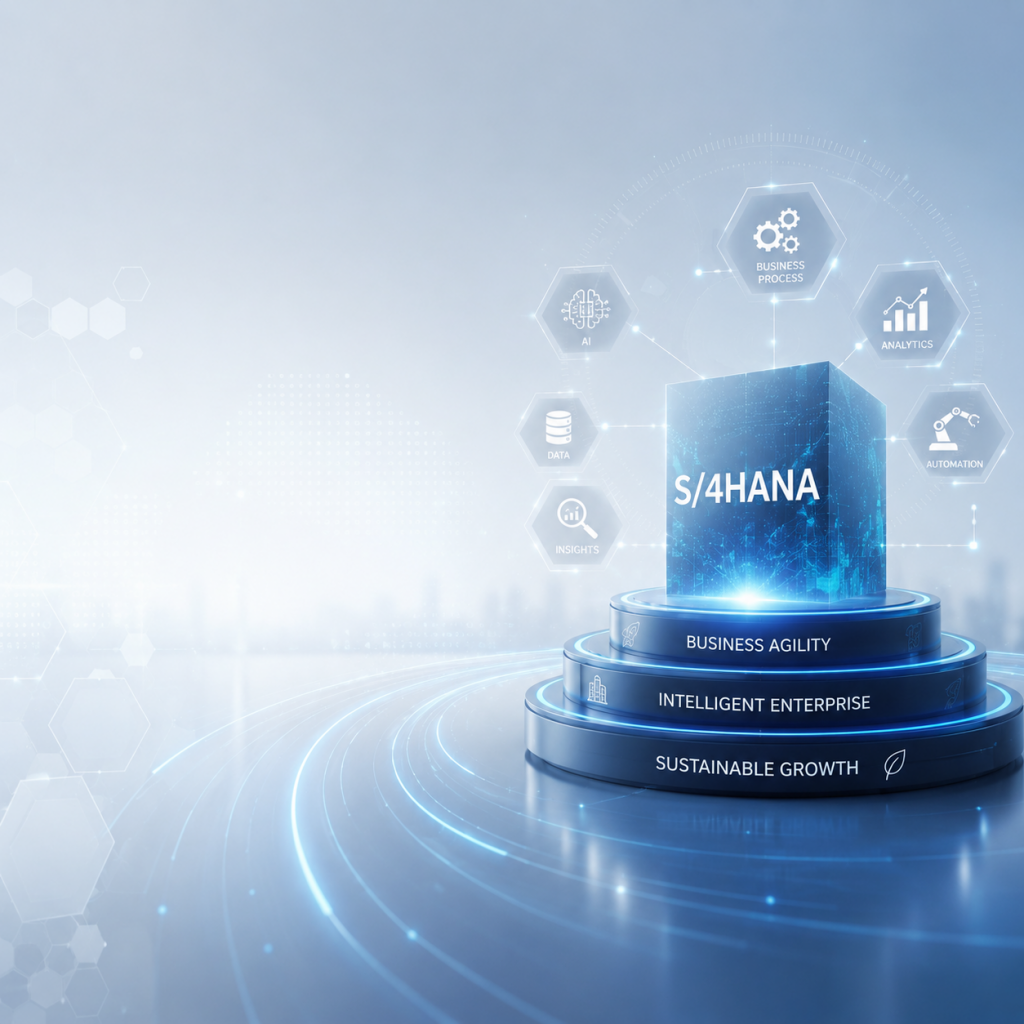
For many organizations, completing an S/4HANA migration feels like crossing the finish line. The project is live, business users have adapted to new processes, and attention shifts back to day-to-day operations.
In reality, S/4HANA is often the starting point rather than the destination. The core system gives you a clean, real-time data foundation — but clean core, AI-first architecture, and now the shift to BAIP all point to the same conclusion: the ERP is the system of record, while the real transformation — AI, automation, and extensibility — increasingly happens on the platform layer around it.
One question comes up in almost every post-go-live conversation we have with customers:
“Now that we’re on S/4HANA, what should we do with SAP BAIP?”
Having worked with organizations across industries on this exact question, we've observed a clear pattern among the ones that get it right: the most successful companies use SAP Business AI Platform (BAIP, previously BTP) to solve business challenges that are difficult, expensive, or risky to address directly within the ERP system.
The Mistake Many Organizations Make
After an S/4HANA migration, there is often enthusiasm to adopt every new SAP innovation available — AI, automation, analytics, low-code applications, integrations, and more. The challenge is that many initiatives start with technology rather than business outcomes.
Start with business problems, not platform capabilities. BAIP should enable business transformation — it shouldn't become a transformation project in its own right.
A Four-Phase Approach
Rather than treating BAIP adoption as a single initiative, we structure it as four phases that build on each other. Timelines vary by organization, but most clients move through them within their first year post-go-live. Phases 1 and 2 both fall in the Months 0–3 window by design — they run in parallel rather than in sequence, since stabilizing the core and scoping the first AI use case draw on different teams and don't compete for the same time.
Months 0–3
Months 0–3 · in parallel
Months 3–6
Months 6–12
Phase 1: Stabilize the Core
The first priority after go-live is protecting the investment already made. Organizations should focus on:
This stabilization period often surfaces inefficiencies that were hidden during the migration project, and it creates a cleaner foundation for innovation. On recent engagements, we've used this window to review Fiori adoption against legacy SAP GUI usage — tracking that ratio over time gives a concrete, data-backed signal for where user adoption gaps still exist, rather than relying on anecdotal feedback.
Phase 2: Introduce AI Early — With Purpose
Business leaders no longer treat AI as a future initiative — by the time an S/4HANA migration goes live, the conversation has usually already started. SAP's own platform naming reflects this shift: effective mid-2026, SAP evolved BTP into the SAP Business AI Platform (BAIP), folding in SAP Business Data Cloud and SAP Business Transformation Management alongside it. It's more than a cosmetic rebrand — it signals that AI is no longer treated as an add-on to the platform, but as core to how the platform is positioned and built. For customers, the practical significance is that AI, data, and automation are now delivered as one unified foundation rather than three separately stitched-together layers — which should simplify how future use cases get architected and governed. The key on the ground is not to launch a large AI program immediately, but to identify one or two focused use cases that deliver measurable value within the first few months. Common starting points include:
The organizations that succeed prove value on one or two use cases before scaling. Implemented correctly, AI becomes an extension of existing business processes rather than a standalone experiment.
Phase 3: Extend Without Modifying
One of the biggest advantages of SAP BAIP is the ability to extend business processes without modifying the S/4HANA core. Historically, ECC systems accumulated years of customizations, making upgrades and maintenance increasingly difficult. The clean-core approach reverses that: instead of building inside the ERP, organizations create side-by-side extensions on BAIP. Common examples include:
We've applied this same principle building custom Fiori dashboards that pull KPIs directly from Cloud ALM's Real User Monitoring APIs — giving stakeholders live operational visibility without touching core configuration.
Phase 4: Automate and Modernize Integrations
Even after S/4HANA adoption, many organizations still rely on email approvals, spreadsheets, and manual document handling. SAP Build Process Automation offers a quick path to improving efficiency and process visibility across:
At the same time, integration complexity keeps growing as organizations adopt more cloud applications — a typical landscape spans S/4HANA, SuccessFactors, Ariba, Concur, Salesforce, Microsoft applications, and various third-party systems. Rather than building point-to-point integrations, we recommend a scalable integration architecture on SAP Integration Suite. This reduces long-term maintenance effort and gives the landscape room to evolve as business needs change.
Beyond 12 Months: Where This Leads
Organizations that follow this progression typically arrive at:
Final Thoughts
An S/4HANA migration is a significant milestone, but it isn't the end of the transformation journey. Organizations that realize the greatest value from SAP BAIP follow a balanced approach: they stabilize the core, introduce targeted AI and automation early, extend business processes without touching the ERP, and build a scalable platform for future innovation.
The question today isn't whether to adopt AI after S/4HANA — it's how quickly an organization can identify the right use cases and convert them into measurable business value.
About the Author