

It’s Friday evening. Business users have logged off, the Basis team has initiated the SUM conversion, and project managers are counting down to cutover. To many, this is where a Brownfield migration begins.
For the Brownfield technical team, however, the real journey started months earlier.
Thousands of custom objects have already been assessed. ATC findings have been reviewed. Integrations have been validated. SPDD and SPAU strategies have been debated. Every enhancement has been questioned.
Brownfield isn’t defined by the conversion weekend.
It is defined by the months of technical decisions that make that weekend uneventful.
The Myth of “Just an Upgrade”
Brownfield migration is often described as a system conversion from SAP ECC to SAP S/4HANA. While technically accurate, that definition misses the bigger picture.
Every Brownfield project is an opportunity to modernize the SAP landscape, reduce technical debt, and prepare the platform for future innovation. This article explores why Brownfield is misunderstood — and why technical architects play a pivotal role in its success.
The Journey Begins Long Before Go Live
Long before the production cutover weekend, technical teams begin understanding the SAP landscape they are about to transform. During the early discovery and planning stages, activities such as SAP Readiness Check, custom code inventory, ATC analysis, usage analytics (SCMON/UPL), integration assessment, and landscape sizing provide a comprehensive view of the existing system.
The goal extends beyond estimating project effort. It is to understand what the organization has built over the years, identify technical debt, and determine whether each customization should be retained, reused, rebuilt, or retired as part of the journey to SAP S/4HANA. These early architectural decisions lay the foundation for a successful Brownfield transformation.
A successful Brownfield migration is not defined by the production conversion weekend. It is the result of months of preparation, coordinated technical workstreams, and informed architectural decisions that shape the future SAP landscape.
What Really Happens During a Brownfield Migration
Brownfield is a coordinated effort across multiple technical workstreams:
No single activity guarantees success. It is the discipline across all workstreams that reduces project risk.
Architect’s Corner
The Technical Debt You Didn’t Know You Had
One of the greatest values of a Brownfield migration is the visibility it provides into hidden technical debt:
S/4HANA does not create these problems; it reveals them. Brownfield offers a rare opportunity to simplify rather than carry unnecessary complexity forward.
A Rare Opportunity to Build a Clean Core
One of the biggest misconceptions about Clean Core is that it requires organizations to eliminate all custom developments. That is not the objective.
Clean Core is about making the right architectural decisions for every custom object within the SAP landscape. The goal is to minimize technical debt, maximize the use of SAP standard capabilities, and ensure future upgrades remain simple and predictable.
A practical way to approach this decision-making is through the R3 Framework:
1. Retire
The first question to ask is: Does this custom object still provide business value?
Many SAP systems contain reports, enhancements, interfaces, and programs that are no longer used but continue to increase maintenance effort.
If a custom object is obsolete or no longer serves a business purpose, the best decision is to retire it rather than carry unnecessary technical debt into SAP S/4HANA.
2. Reuse
If the custom development is still required, the next question is: Can the same business requirement be fulfilled using SAP standard functionality?
Over the years, SAP has introduced numerous standard features and business processes that replace custom developments built in earlier ECC implementations.
If SAP now provides the required functionality through standard applications, business processes, or released APIs, organizations should reuse the SAP standard capability instead of maintaining custom code.
3. Rebuild
If the requirement cannot be retired or fulfilled using SAP standard functionality, the custom solution should be rebuilt using SAP-recommended extensibility options that align with Clean Core principles.
Depending on the business requirement, organizations can choose one of the following extensibility approaches:
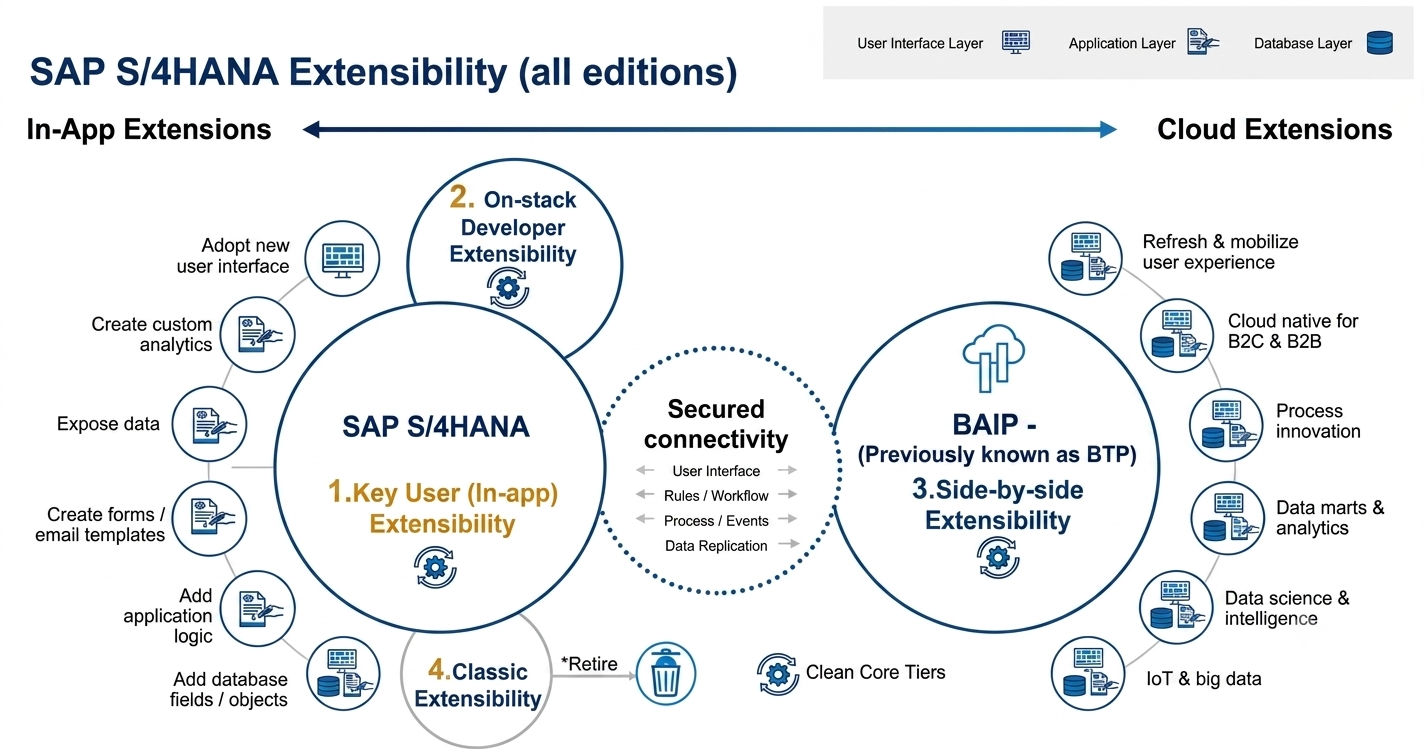
This approach ensures that innovation is delivered without compromising upgradeability or maintainability.
The Next Chapter: AI Assisted Brownfield
Not long ago, a typical day for an ABAP developer during a Brownfield migration began with a long list of ATC findings.
Hundreds—sometimes thousands—of custom objects needed attention. Developers would manually analyze each finding, understand the impact of SAP S/4HANA simplification items, search through SAP Notes, identify the appropriate remediation approach, implement code changes, and repeat the process again and again.
While this work was essential, much of it was repetitive and time-consuming, leaving less time for the architectural decisions that truly required technical expertise.
That experience is beginning to change.
SAP's S/4HANA Custom Code Migration Agent, powered by Joule for Developers, brings AI-driven automation to Brownfield migrations by executing ATC checks, analyzing findings, applying deterministic quick fixes, and generating intelligent code remediation recommendations. This significantly reduces manual effort, accelerates custom code adaptation, and allows developers to focus on business validation and architectural decision-making rather than repetitive remediation tasks.
Beyond code remediation, AI is also accelerating broader modernization activities by helping teams understand object dependencies, generate technical documentation, identify potential impacts across custom developments, and recommend modernization and refactoring approaches. Instead of replacing developers, AI augments their capabilities, enabling them to spend more time designing scalable, Clean Core–aligned solutions and less time performing repetitive engineering tasks.
Brownfield migrations have always been about balancing technical change with business continuity. AI doesn't replace that responsibility—it empowers architects and developers to modernize SAP landscapes faster, smarter, and with greater confidence.
From the Architect’s Desk
Across Brownfield engagements, one lesson repeats itself:
The greatest risk is rarely the conversion tool. The greater risk is assuming every customization deserves to survive.
Successful projects ask “Do we still need this?” before asking “How do we migrate it?”.
Key Takeaways
One Final Thought
When people remember a Brownfield project, they often remember the conversion weekend.
Architects remember something different — the conversations months before go live:
Those decisions — not the conversion itself — determine whether a Brownfield project merely upgrades an ERP system or truly modernizes an enterprise.
Because Brownfield isn’t about carrying the past into S/4HANA. It’s about deciding what deserves to be part of its future.
About the Author

Nice blog Gaja!