In every SAP transformation, two questions quietly shape the success of the entire journey: "Do we truly understand how our processes run today?" and "Do we have a clear picture of our application and integration landscape?"
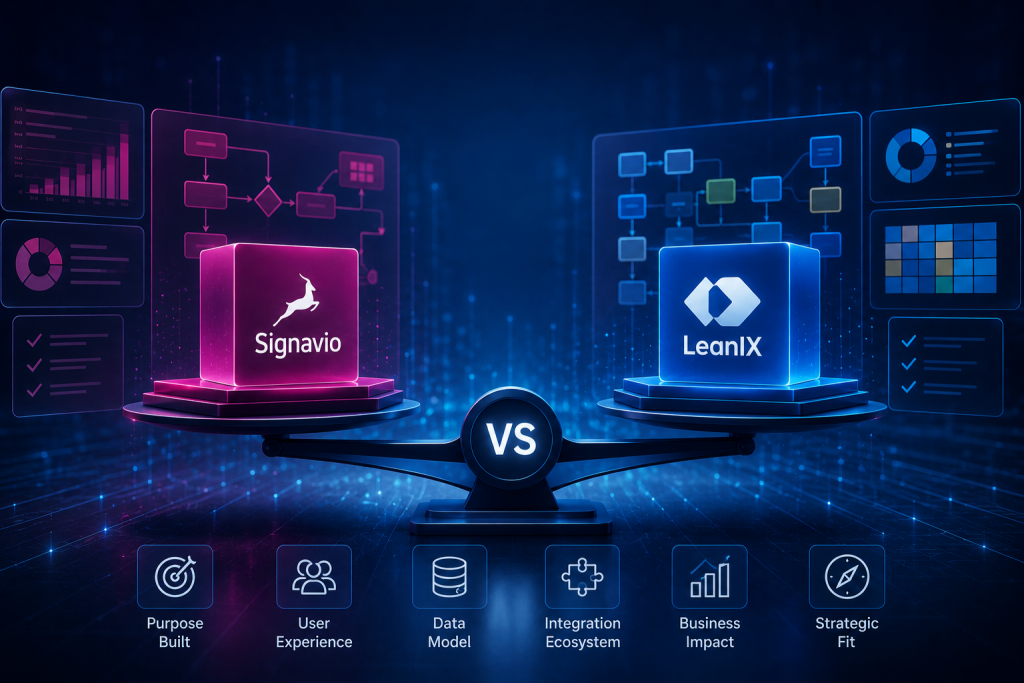
SAP Signavio and LeanIX answer these questions from two different but equally essential angles. Their roles are distinct — and understanding those distinctions is critical for any organization preparing for transformation.
Signavio shows how your business runs. LeanIX shows how your systems support that business.
ITR brings the expertise to connect both — and turn insight into transformation. Used in isolation, each tool is powerful. Used together with the right interpretation, they become a strategic transformation engine.
How Signavio and LeanIX Differ — And Why Both Matter
The temptation is to treat these tools as alternatives. They are not. They operate on different layers of the enterprise and answer fundamentally different questions. Understanding where each one excels — and where they complement each other — is what separates organizations that use them well from those that don't.
| Dimension | SAP Signavio | LeanIX |
|---|---|---|
| Primary Focus | Business processes and how work flows across the enterprise | Application landscape and how systems interact and evolve |
| Truth It Reveals | Operational truth — how processes behave in real life, not on paper | Architectural truth — how the IT landscape has evolved and where risks live |
| Acceleration | Process standardization — which variants to harmonize, where SAP Best Practices fit | Landscape simplification — which apps to retire, consolidate, or move to BTP |
| Alignment | Business alignment — Finance, Procurement, Supply Chain grounded in real data | IT alignment — architecture and SAP teams on a single source of truth |
| Risk Reduction | Process-related risk — eliminating assumptions from redesign decisions | Technology-related risk — surfacing dependencies and end-of-life systems early |
Where Signavio and LeanIX Complement Each Other
The most powerful transformation programs use both tools in concert. Signavio identifies the problem; LeanIX locates it in the landscape. Signavio highlights the opportunity; LeanIX confirms whether it's achievable.
Process Gaps Meet System Gaps
Signavio may reveal too many manual approvals in procurement. LeanIX then shows which systems and integrations are involved — determining whether the fix is process-driven, system-driven, or both.
Automation Opportunities, Correctly Placed
Signavio surfaces repetitive manual steps that slow operations. LeanIX determines whether automation should live in S/4HANA, BTP, or a system being retired — preventing misplaced investment.
Clean-Core Decisions, Fully Validated
Signavio shows which processes can adopt SAP standard. LeanIX confirms whether the surrounding systems and integrations can support that standardization without breaking downstream flows.
Blueprinting Meets Technical Design
Signavio gives functional teams clarity on what needs to change. LeanIX gives technical teams clarity on how those changes impact the broader landscape — closing the gap between design and reality.
Where ITR Brings a Distinct Advantage in Using Both Tools Together
Insights from Signavio and LeanIX are only as valuable as the expertise used to interpret and act on them. ITR understands how process deviations and architectural complexity translate into configuration, integration, and clean-core decisions — ensuring insights from both tools flow directly into S/4HANA design rather than sitting in reports.
The Combined Value ITR Delivers
How ITR Helps Customers Maximize Value From Both Tools
ITR structures Signavio and LeanIX engagements around the transformation decisions that matter most — not as separate workstreams, but as an integrated intelligence layer that informs every design and roadmap choice.
ITR's Combined Service Portfolio
Where we drive the most impact:
How ITR Stabilizes Transformation Across Both Dimensions
The Bottom Line
Signavio shows how your business runs. LeanIX shows how your systems support that business. ITR brings the expertise to connect both — and turn insight into transformation.
In a world where SAP landscapes are becoming more integrated, more cloud-driven, and more business-critical, this combination is what helps enterprises move forward with clarity, confidence, and control.
For organizations preparing for S/4HANA, clean-core adoption, or long-term modernization, process visibility and architectural visibility are not separate investments — they are two sides of the same transformation.
About the Author